The Bullet That Didn’t Kill Him — But Almost Killed Me: A Story of Childhood Trauma, Silence, and Survival
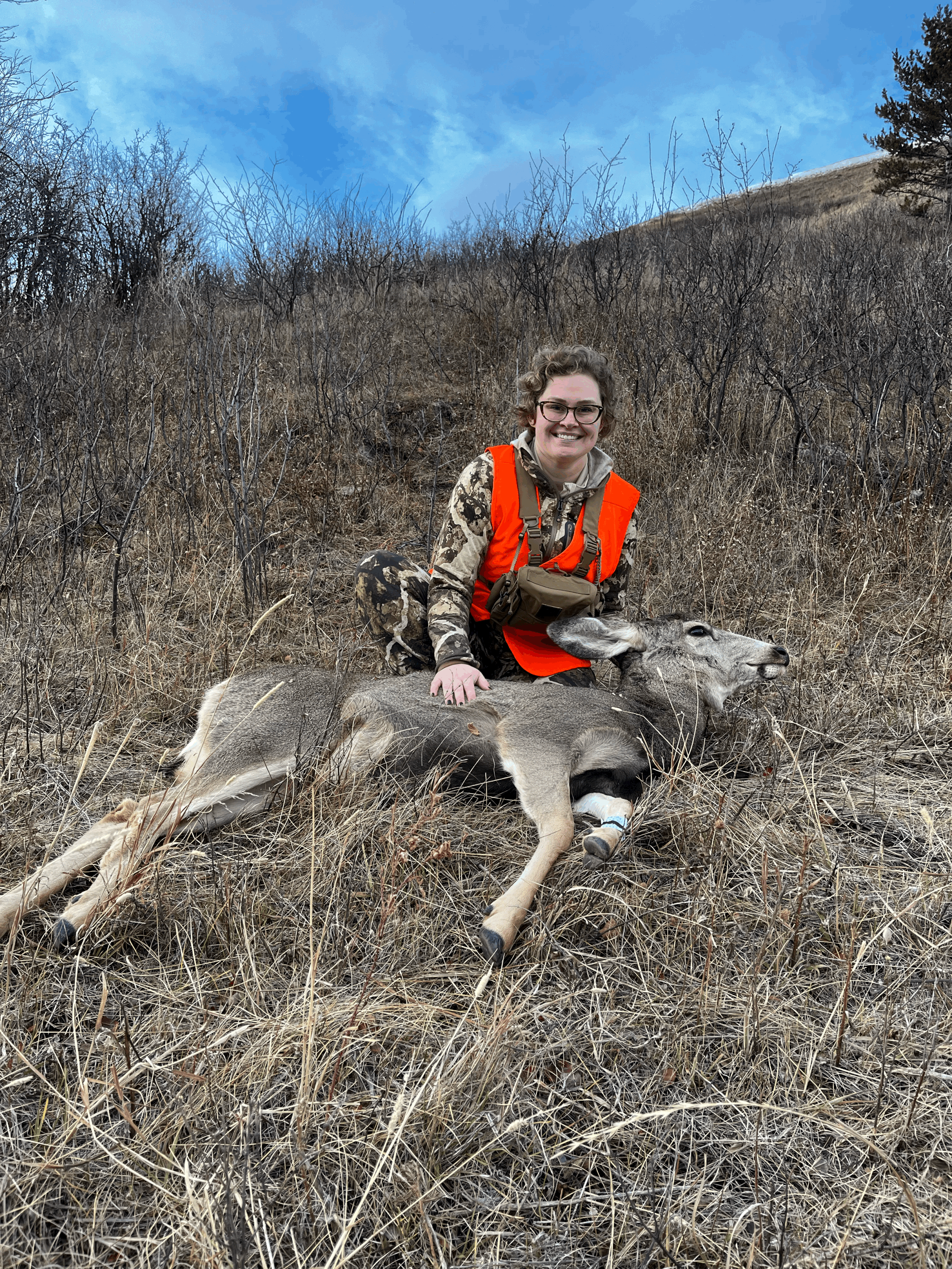
Seventeen years after the accident, I finally harvested my first mule deer doe. Not for sport — but for healing. For the girl who thought she’d never pick up a rifle again, and the woman who learned she could.
By Frankie — Disabled Air Force Veteran | Chronic Illness Advocate | Medical Nerd
⚠️ Trigger Warning: This story discusses a firearm accident, childhood trauma, and references to suicidal thoughts. Reader discretion advised.
Some moments don’t just change you — they grow you up before you know how to be grown.
I was 12 years old the day I stopped being a child.
And it happened in the wide-open sagebrush country of eastern Montana — a place I once loved for its freedom and silence.
A place that would go silent in a whole new way that day.
The First Harvest and the Shot That Shouldn’t Have Happened
“I was walking up on my first buck, full of pride and innocence — within seconds, everything I knew about safety, confidence, and who I thought I was shattered.”
It was my first year hunting, just two years after completing hunter’s safety — which in Montana isn’t just a class; it’s a rite of passage.
I was with my father, grandfather, and brother. We’d split up at first, planning to meet back at a predetermined ridge. I was over the moon — I’d just shot my first mule deer buck. A 4x5. He was beautiful. I was proud. I had arrived.
As I walked up to the animal, I turned to look back — thinking no one was behind me.
I was wrong.
In a split-second that still plays in slow motion in my mind — my rifle suddenly fired.
There was no warning. No conscious pull of the trigger. The sound shattered the sky and hollowed my hearing. My vision darkened. I felt frozen inside a body that had just experienced something I couldn’t comprehend.
When my hearing and sight started to return, they came back in pieces — first the ringing, then the panic, and then my dad’s voice:
“FRANKIE!! FRANK!! START RUNNING! CHASE THAT TRUCK! RUN!!”
His voice wasn't calm. It was pure panic, urgency, and fear.
And it snapped me into action.
A Run for Help — And a Moment I’ll Never Forget
I took off running.
The sage tore at my legs. My lungs seared. I stumbled, fell, got back up. I screamed so hard nothing came out. I just ran until I caught up to a truck, waving my arms, begging it to stop.
The truck finally did.
A tall man with dark hair in a red plaid jacket and hunter’s orange vest jumped out of the cab and ran toward me. I collapsed into his arms, shaking, barely able to breathe.
I somehow managed to say:
“My grandpa — he’s been shot! It was an accident.”
He grabbed his radio instantly and called it in. We were instructed to meet the ambulance on the highway.
My brother and I turned to wait for our dad and grandfather.
And then — I saw them.
The Only Voice That Spoke Truth
My grandfather didn’t collapse where he stood.
He walked half a mile — with a bullet in his abdomen — up to the road where I was waiting by my dad’s Bronco. He was holding his side, pale, sweating, covered in pain and determination.
When he reached me, he didn’t speak at first.
He just handed me his binoculars — the ones the bullet had ricocheted off of, the ones that had saved his life.
Then he laid down on the ground with his head in my lap.
He looked up at me with eyes half-lidded from pain and said:
“I'm tired, Frankie. Don’t let me go to sleep.”
I’ll never forget the weight of him in my lap — or the terror of believing I might lose him right then and there, in my arms, not during a hunt, but because of something I couldn’t even make sense of.
After that, he climbed into my dad’s Bronco, and we drove to meet the waiting ambulance.
He survived.
“I remember the world going silent — and the silence stayed long after the sound of the shot was gone.”
The Silence That Followed
After surgery, I was the first person he wanted to see.
He held my hand and told me:
“This was not your fault. I don’t blame you. I’m not mad.”
I believed him — or tried to.
But no one else said those words.
My grandmother wouldn’t look at me. The adults went quiet. The police questioned me.
And after one brief session with a school therapist, I was deemed “fine.”
I wasn’t fine.
When Trauma Is Treated Like a Fluke
Childhood trauma isn’t just about what happens to you.
It’s about what happens after.
When adults don’t talk to you, don’t help you process, don’t believe you — the wound goes uncleaned.
Unfelt pain doesn’t vanish.
It festers.
It waits.
Growing Up in the Quiet
For years, I replayed that day over and over, trying to make sense of it.
Trying to figure out how the rifle fired.
Trying to understand what I’d done — and why no one was talking about it.
I knew my finger wasn’t on the trigger. I knew I followed the rules. I knew I hadn’t reloaded — and yet I was the one the police pulled aside. I was the one who got quiet stares. I was the one who went silent — because silence seemed safer than saying, “I don’t understand what happened.”
But staying silent came at a cost.
I didn’t just stop being a child that day — I stopped knowing how to be alive in a world that expected me to carry on as if nothing had happened.
I internalized the blame.
I turned the confusion and guilt inward.
I became afraid of myself — afraid of what I’d done, and what I might do.
I was terrified, constantly, that I was capable of causing harm without knowing how or why.
And no one saw it.
No one checked in after the hospital.
No one asked how I was sleeping, or if I was eating.
I withdrew.
I masked.
And as a result — I spiraled.
Nights were the worst. I had vivid nightmares. Terrifying reenactments. Sweaty flashbacks I couldn’t escape from.
And slowly, without language for what I was feeling, the only escape I saw was not being alive anymore.
I was a child silently contemplating death — because I thought that was the only way to escape what I'd allegedly done.
That’s what untreated trauma does — especially to an undiagnosed autistic kid with ADHD living in an abusive home, where feelings weren’t safe and silence was survival.
When you learn that your pain isn’t welcome, you stop showing it.
And when you're never taught how to process the unbearable, it turns inward.
A Question That Changed Everything
Years later, when I was finally diagnosed with PTSD, my psychiatrist asked me something I had never allowed myself to consider:
“Frankie, your father is an alcoholic and you know your finger wasn’t on the trigger. What if your father was the one who accidentally shot your grandfather… and you were made to believe it was you?”
That question changed everything.
It cracked open years of silence and self-blame, forcing me to see the possibility that the story I’d carried might never have been entirely mine to bear. I may never know the full truth — but I know that little girl deserved to be believed, protected, and guided through this.
Instead, she was left to survive the weight of everyone else’s fear.
How I Reclaimed the Wild
I didn’t go back to hunting for fourteen years.
It wasn’t until I met my husband in 2018 that I picked up a rifle again and it would be three more years before I harvested my first deer seen in the picture above
.
With him, hunting became something different — not about ego or perfection, but about connection, sustainability, and healing.
It was the first time I saw hunting as a way to reclaim the parts of myself I’d buried.
To step back into the wild without fear — and with reverence.
Now, even with POTS, brain injury, significant hearing loss and auditory and visueal processing issues, visual impairment, and neuro fatigue — I still go.
Not to prove I’m capable.
But to remind myself that I still belong.
Because the wild didn’t abandon me — people did.
For the Child I Was and the Woman I Am
If I could speak to that 12-year-old girl now, I’d tell her:
You didn’t do anything wrong.
There were layers of things working against you.
You followed the rules.
And the silence that followed wasn’t your fault either.
You didn’t deserve the blame.
You didn’t deserve the shame.
You didn’t deserve to be alone in that pain.
And one day — you’ll find your way back to those sage-covered hills.
Not as the child who fell —
But as the woman who rose.
If this story speaks to anything you’ve carried alone — childhood trauma, chronic illness, neurodivergence, or the long road back to yourself — I hope you’ll stay with me, follow along @thechronicallyresilient.
And as always, Stay Resilient. ❤️🩹
When the Wild Becomes a Mirror: Hunting With a Brain Injury, POTS, and Fading Senses
Hunting with POTS, visual processing issues, and brain injury isn’t just physically demanding — it’s a daily lesson in resilience, adaptation, and honoring your limits.
By Frankie — Disabled Air Force Veteran | Chronic Illness Advocate | Medical Nerd
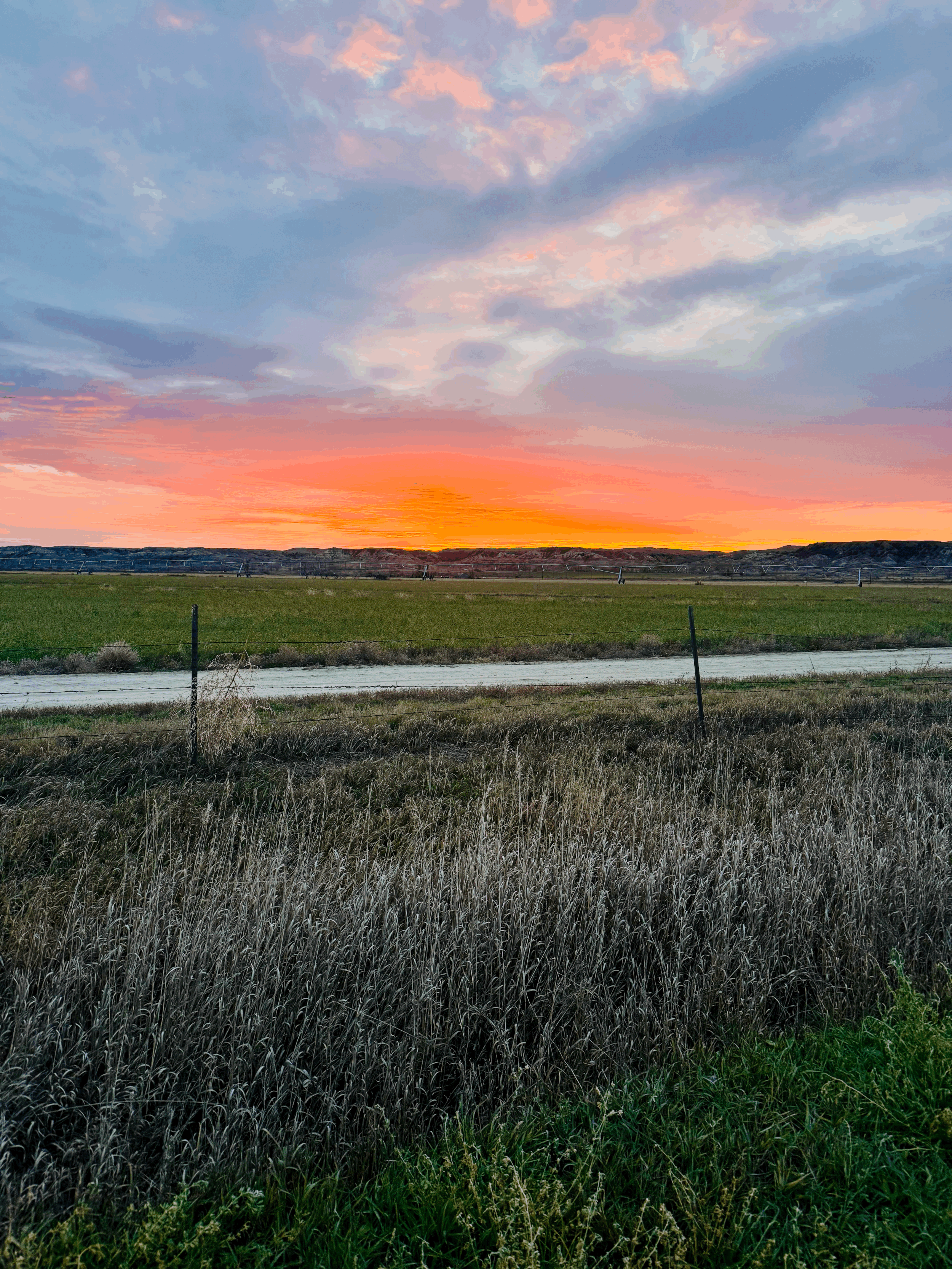
There’s something about watching the sun crawl across the eastern Montana sky that reminds me I’m still here — still fighting, still learning what this new version of my body can and can’t do.
This year’s antelope hunt wasn’t just about the chase. It was about reckoning — with my body, with my brain, and with the stillness that comes after realizing even the wild doesn’t quiet the storm inside you anymore.
Between the Wind and the Wild: When Your Eyes Aren’t Your Own
“It’s like trying to hold still in an earthquake — my vision feels shaky, like I can’t anchor to the world long enough to aim, to trust my body.”
The rolling hills of eastern Montana are gentle — slow sloping, wind-laced, and dotted with sage — but even walking them feels like scaling a mountain. The moment there’s any incline, my heart rate spikes to nearly 170 bpm. I live with POTS — and the unpredictability of how my body responds means I never fully know if it’s going to cooperate.
And when my heart is pounding, my vision starts to go with it.
My brain can’t focus the way it used to. Objects feel “shaky,” and no matter how much I steady my breathing or brace my rifle, the world won’t hold still. Even spotting an antelope — something I could do in seconds a few years ago — becomes almost impossible through a scope that never stops quivering.
When my heart races, my ability to see declines. But that’s not by accident.
Why Vision and POTS Are Linked
POTS (Postural Orthostatic Tachycardia Syndrome) forces your heart to work overtime just to keep blood circulating, especially when you stand or exert yourself.
When your heart rate skyrockets:
Your body diverts blood from “non-essential” systems (like vision and digestion) to protect vital organs.
Result: Blurry, shaky vision and poor visual focus.
Add in brain-injury-related visual processing issues, and it becomes a full-blown sensory bottleneck.
Losing My Senses, One Step at a Time
“Hunting demands silence. But how do you stay silent when you can’t hear yourself?”
I can’t wear my hearing aids while I hunt — sweat from POTS could fry them, and they’re not waterproof. That means I enter the field unable to fully hear my surroundings.
Every step becomes a gamble:
Am I too loud? Am I missing something? Am I safe?
I rely on my husband, who walks in front of me — his footsteps become my guide, his silence my cue. I use all my energy to keep my eyes on his heels, just trying to stay quiet and balanced in a world that now feels foreign in both sound and sight.
Even speaking becomes complicated. I can’t tell how loud I am, and sometimes I accidentally whisper too loudly — breaking the stillness we’ve worked so hard to create.
“When your body becomes both the barrier and the battleground, even whispering is a test of control.”
The Moment I Knew the Hunt Was Over
We hunted for four days — two trips out per day. I pushed hard, watching the sunrise in awe, enduring windburn on my face and fatigue in open defiance of my symptoms. But on Tuesday morning, as we crested a hill in search of a herd we’d been tracking, it hit me like a wave:
I had nothing left to give.
My brain fogged. Speech processing started crashing. Noise, balance, breathing — every system in my body was begging me to stop. The antelope were still out there, but I wasn’t.
So we called the hunt.
I walked away empty-handed — but not empty-hearted.
This Body Still Belongs Outside
“Grief lives here alongside grit. I hate what I’ve lost. But I love that I still go.”
Hunting isn’t just something I do — it’s something I share. My husband and I rebuilt parts of our relationship in these landscapes. I learned to slow down again, to listen to the wind and let nature carry the weight of what I can no longer hold.
I didn’t grow up thinking “someday my brain injury will affect my ability to aim a rifle,” but here we are. My MRI shows tissue damage and encephalomalacia — silent, structural reminders of what gamma knife surgery cost me. And yet:
I am still here.
I still show up.
I still learn new ways to live.
Because being alive isn’t about bouncing back.
It’s about adapting forward.
The Damage You Can’t See
My MRI shows:
Encephalomalacia and gliosis: Brain tissue damage and scarring from radiation and A/V malformation.
Visual processing issues: From tissue loss in areas related to perception and eye tracking.
Major Neurocognitive Disorder: Diagnosis stemming from these changes.
That’s why I’m starting occupational and speech therapy — to regain even a sliver of control over what’s been lost.
Ending on Purpose
I used to think pushing through pain meant I was strong. That ignoring my limits made me worthy.
Now I know this:
Honoring my limitations is how I stay in the game.
I left the wild empty-handed this time. But I walked away with the kind of pride you can’t hang on a wall — the kind that exists in every breath I didn’t give up, every step I took beside the man who taught me to love hunting again.
I’m not done. I’m just learning how to hunt a different way.
If this resonates with you, and you’d like to follow my journey of neurodivergence, chronic illness, healing, and everyday resilience — you can follow me on social media @thechronicallyresilient
And as always, Stay Resilient ❤️🩹