When the Wires Cross: Living with Autism, ADHD, and Major Neurocognitive Disorder (Post-Radiation Brain Injury)
There are moments when my brain feels like a tangled set of wires — sparks of clarity flickering between darkened circuits. I may lose words, forget paths I once knew, and fumble through conversation, but I’ve learned that resilience isn’t about restoring what was lost. It’s about finding new ways to illuminate what remains.
© thechronicallyresilient
By Frankie — Disabled Air Force Veteran | Chronic Illness Advocate | Social Scientist
Living with autism and ADHD is already complex. The constant juggling act between sensory overwhelm, executive dysfunction, and social decoding takes a tremendous amount of invisible effort. But when you add Major Neurocognitive Disorder (MND) — the medical term for dementia — caused by radiation-induced brain injury after Gamma Knife surgery, the wires of my mind don’t just cross — they sometimes go completely dark.
Understanding the Overlap
Autism and ADHD alone make life a constant negotiation between ability and exhaustion. For me, that meant years of masking — forcing myself to appear “normal,” pushing through sensory chaos, scripting conversations, and maintaining an image of competence even when my brain was on fire inside. But when I developed MND, masking became impossible.
Major Neurocognitive Disorder is often associated with aging, but it can happen at any age. It’s essentially dementia, caused by damage to the brain. In my case, it was a delayed consequence of Gamma Knife radiation used to treat a cerebral arteriovenous malformation — a rare tangle of blood vessels in my brain. What saved my life also fundamentally changed it.
Losing the Words — and Pieces of Myself
There are large chunks of my memory that are simply gone. I can’t recall moments that once shaped who I was. I struggle to find words mid-sentence, my thoughts evaporating before I can anchor them. Sometimes I lose track of what I’m saying entirely.
Conversations that used to feel natural now require enormous concentration. I can’t always interpret tone or filter background noise, and complex instructions leave me frozen. I get confused easily, lost in places I used to navigate without thinking. And every time it happens, I feel a pang of grief — not just for what I’ve lost, but for the people who’ve lost the version of me who could once keep everything straight.
“I used to be dependable — now I’m not, but not at any fault of my own.”
Relationships strain under the weight of my limitations. People assume I’m the same because I still sound articulate, but the truth is, I’m holding things together with fragile threads. My brain works differently now, and no amount of willpower can restore what radiation quietly took from me.
When Masking Becomes Impossible
Before MND, I could still mask my autism and ADHD well enough to survive most social situations. I could prepare scripts, hide overstimulation, and push through burnout. Now, I don’t have that luxury.
The fatigue that comes from cognitive impairment strips away every buffer I once relied on. The filters are gone. My patience for superficiality has worn thin. I say what I mean, even when it’s not what others want to hear. Some call that “difficult.” I call it unfiltered honesty.
“Neurodivergence stripped away my camouflage — but maybe it also stripped me down to my truest self.”
The Loneliness of Not Being Believed
Even doctors sometimes don’t believe me. I’ve become too good at masking my symptoms — at performing competence long enough to pass brief assessments. They see a well-spoken, intelligent adult and assume my brain injury couldn’t be “that bad.” But they don’t see the hours afterward when I crash, disoriented and drained from holding it together.
Being autistic already means living in a world that misunderstands your inner experience. Adding cognitive decline to that creates an isolation that’s hard to describe. It’s a loneliness not just of company, but of comprehension.
The Grief and the Grit
There’s deep grief in realizing that the person I was — the one who could multitask, solve problems, and organize chaos — isn’t coming back. But there’s also resilience in learning how to live differently.
I’ve learned to slow down. To rely on visual aids, notes, alarms, and routines. I give myself grace when I lose words mid-sentence. I find peace in smaller victories — remembering an appointment, finishing a task, making it through a conversation without losing my place.
“This isn’t the life I planned, but it’s still a life worth living — one that demands compassion, creativity, and constant adaptation.”
A Call for Understanding
Major Neurocognitive Disorder doesn’t just happen to the elderly. It can affect people in their 20s, 30s, and 40s — people with families, careers, and lives in progress. It deserves the same level of recognition, research, and empathy as any other neurological condition.
We need more awareness of what it means to live with overlapping neurodivergence and acquired cognitive disability — how it shapes communication, relationships, and identity. I may forget details, lose words, or repeat myself, but I never lose my capacity for love, empathy, meaning and understanding.
So I’ll keep telling my story — even when the sentences come slowly, even when the memories fade. Because somewhere out there, another person is quietly wondering if anyone understands what it’s like when your brain no longer functions the way it once did.
And to them, I want to say: I see you. You’re not broken. You’re rebuilding.
If this story resonates with you, follow my journey @thechronicallyresilient.
And as always, Stay Resilient ❤️🩹
The Bullet That Didn’t Kill Him — But Almost Killed Me: A Story of Childhood Trauma, Silence, and Survival
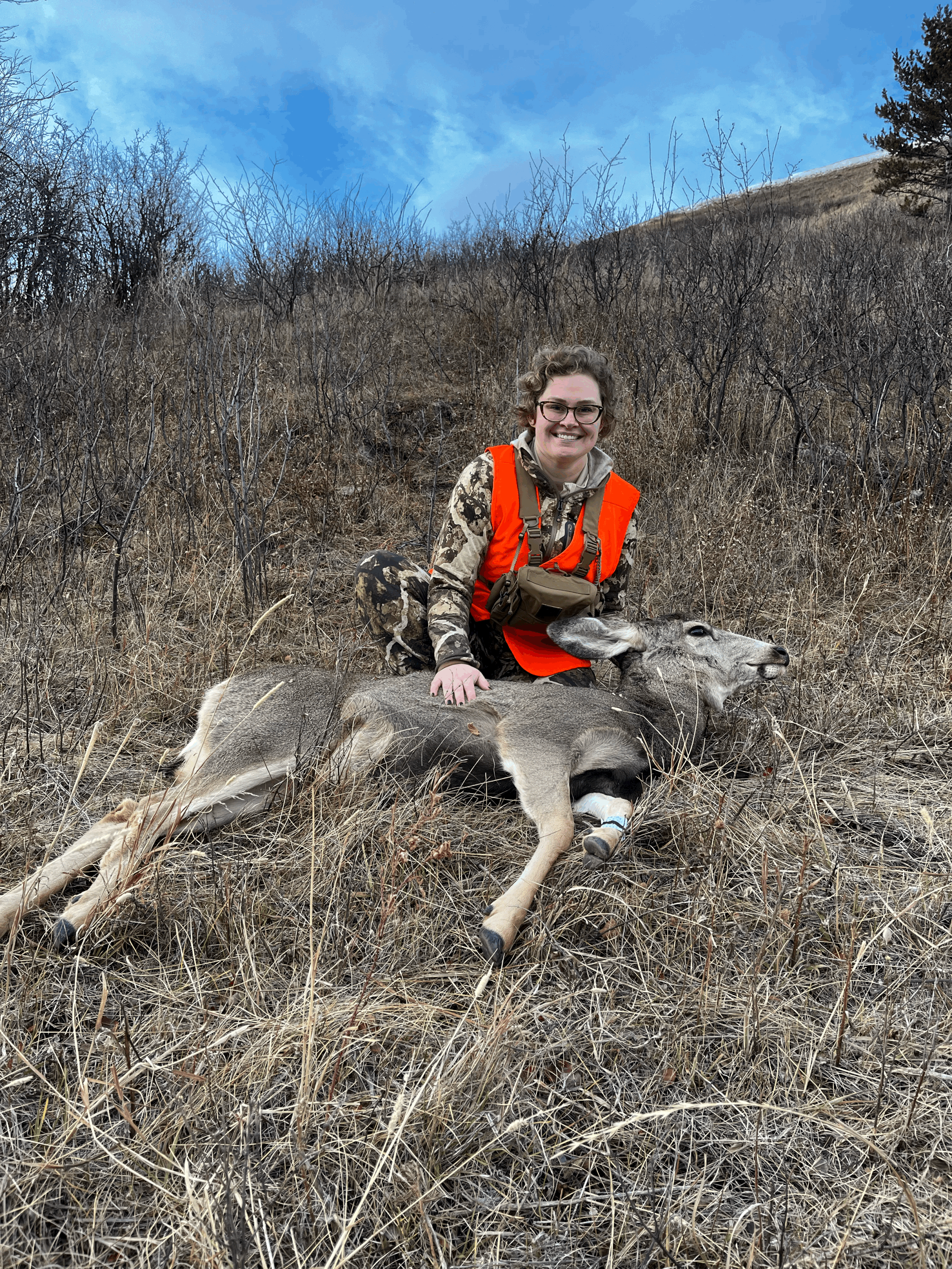
Seventeen years after the accident, I finally harvested my first mule deer doe. Not for sport — but for healing. For the girl who thought she’d never pick up a rifle again, and the woman who learned she could.
By Frankie — Disabled Air Force Veteran | Chronic Illness Advocate | Medical Nerd
⚠️ Trigger Warning: This story discusses a firearm accident, childhood trauma, and references to suicidal thoughts. Reader discretion advised.
Some moments don’t just change you — they grow you up before you know how to be grown.
I was 12 years old the day I stopped being a child.
And it happened in the wide-open sagebrush country of eastern Montana — a place I once loved for its freedom and silence.
A place that would go silent in a whole new way that day.
The First Harvest and the Shot That Shouldn’t Have Happened
“I was walking up on my first buck, full of pride and innocence — within seconds, everything I knew about safety, confidence, and who I thought I was shattered.”
It was my first year hunting, just two years after completing hunter’s safety — which in Montana isn’t just a class; it’s a rite of passage.
I was with my father, grandfather, and brother. We’d split up at first, planning to meet back at a predetermined ridge. I was over the moon — I’d just shot my first mule deer buck. A 4x5. He was beautiful. I was proud. I had arrived.
As I walked up to the animal, I turned to look back — thinking no one was behind me.
I was wrong.
In a split-second that still plays in slow motion in my mind — my rifle suddenly fired.
There was no warning. No conscious pull of the trigger. The sound shattered the sky and hollowed my hearing. My vision darkened. I felt frozen inside a body that had just experienced something I couldn’t comprehend.
When my hearing and sight started to return, they came back in pieces — first the ringing, then the panic, and then my dad’s voice:
“FRANKIE!! FRANK!! START RUNNING! CHASE THAT TRUCK! RUN!!”
His voice wasn't calm. It was pure panic, urgency, and fear.
And it snapped me into action.
A Run for Help — And a Moment I’ll Never Forget
I took off running.
The sage tore at my legs. My lungs seared. I stumbled, fell, got back up. I screamed so hard nothing came out. I just ran until I caught up to a truck, waving my arms, begging it to stop.
The truck finally did.
A tall man with dark hair in a red plaid jacket and hunter’s orange vest jumped out of the cab and ran toward me. I collapsed into his arms, shaking, barely able to breathe.
I somehow managed to say:
“My grandpa — he’s been shot! It was an accident.”
He grabbed his radio instantly and called it in. We were instructed to meet the ambulance on the highway.
My brother and I turned to wait for our dad and grandfather.
And then — I saw them.
The Only Voice That Spoke Truth
My grandfather didn’t collapse where he stood.
He walked half a mile — with a bullet in his abdomen — up to the road where I was waiting by my dad’s Bronco. He was holding his side, pale, sweating, covered in pain and determination.
When he reached me, he didn’t speak at first.
He just handed me his binoculars — the ones the bullet had ricocheted off of, the ones that had saved his life.
Then he laid down on the ground with his head in my lap.
He looked up at me with eyes half-lidded from pain and said:
“I'm tired, Frankie. Don’t let me go to sleep.”
I’ll never forget the weight of him in my lap — or the terror of believing I might lose him right then and there, in my arms, not during a hunt, but because of something I couldn’t even make sense of.
After that, he climbed into my dad’s Bronco, and we drove to meet the waiting ambulance.
He survived.
“I remember the world going silent — and the silence stayed long after the sound of the shot was gone.”
The Silence That Followed
After surgery, I was the first person he wanted to see.
He held my hand and told me:
“This was not your fault. I don’t blame you. I’m not mad.”
I believed him — or tried to.
But no one else said those words.
My grandmother wouldn’t look at me. The adults went quiet. The police questioned me.
And after one brief session with a school therapist, I was deemed “fine.”
I wasn’t fine.
When Trauma Is Treated Like a Fluke
Childhood trauma isn’t just about what happens to you.
It’s about what happens after.
When adults don’t talk to you, don’t help you process, don’t believe you — the wound goes uncleaned.
Unfelt pain doesn’t vanish.
It festers.
It waits.
Growing Up in the Quiet
For years, I replayed that day over and over, trying to make sense of it.
Trying to figure out how the rifle fired.
Trying to understand what I’d done — and why no one was talking about it.
I knew my finger wasn’t on the trigger. I knew I followed the rules. I knew I hadn’t reloaded — and yet I was the one the police pulled aside. I was the one who got quiet stares. I was the one who went silent — because silence seemed safer than saying, “I don’t understand what happened.”
But staying silent came at a cost.
I didn’t just stop being a child that day — I stopped knowing how to be alive in a world that expected me to carry on as if nothing had happened.
I internalized the blame.
I turned the confusion and guilt inward.
I became afraid of myself — afraid of what I’d done, and what I might do.
I was terrified, constantly, that I was capable of causing harm without knowing how or why.
And no one saw it.
No one checked in after the hospital.
No one asked how I was sleeping, or if I was eating.
I withdrew.
I masked.
And as a result — I spiraled.
Nights were the worst. I had vivid nightmares. Terrifying reenactments. Sweaty flashbacks I couldn’t escape from.
And slowly, without language for what I was feeling, the only escape I saw was not being alive anymore.
I was a child silently contemplating death — because I thought that was the only way to escape what I'd allegedly done.
That’s what untreated trauma does — especially to an undiagnosed autistic kid with ADHD living in an abusive home, where feelings weren’t safe and silence was survival.
When you learn that your pain isn’t welcome, you stop showing it.
And when you're never taught how to process the unbearable, it turns inward.
A Question That Changed Everything
Years later, when I was finally diagnosed with PTSD, my psychiatrist asked me something I had never allowed myself to consider:
“Frankie, your father is an alcoholic and you know your finger wasn’t on the trigger. What if your father was the one who accidentally shot your grandfather… and you were made to believe it was you?”
That question changed everything.
It cracked open years of silence and self-blame, forcing me to see the possibility that the story I’d carried might never have been entirely mine to bear. I may never know the full truth — but I know that little girl deserved to be believed, protected, and guided through this.
Instead, she was left to survive the weight of everyone else’s fear.
How I Reclaimed the Wild
I didn’t go back to hunting for fourteen years.
It wasn’t until I met my husband in 2018 that I picked up a rifle again and it would be three more years before I harvested my first deer seen in the picture above
.
With him, hunting became something different — not about ego or perfection, but about connection, sustainability, and healing.
It was the first time I saw hunting as a way to reclaim the parts of myself I’d buried.
To step back into the wild without fear — and with reverence.
Now, even with POTS, brain injury, significant hearing loss and auditory and visueal processing issues, visual impairment, and neuro fatigue — I still go.
Not to prove I’m capable.
But to remind myself that I still belong.
Because the wild didn’t abandon me — people did.
For the Child I Was and the Woman I Am
If I could speak to that 12-year-old girl now, I’d tell her:
You didn’t do anything wrong.
There were layers of things working against you.
You followed the rules.
And the silence that followed wasn’t your fault either.
You didn’t deserve the blame.
You didn’t deserve the shame.
You didn’t deserve to be alone in that pain.
And one day — you’ll find your way back to those sage-covered hills.
Not as the child who fell —
But as the woman who rose.
If this story speaks to anything you’ve carried alone — childhood trauma, chronic illness, neurodivergence, or the long road back to yourself — I hope you’ll stay with me, follow along @thechronicallyresilient.
And as always, Stay Resilient. ❤️🩹