The Bullet That Didn’t Kill Him — But Almost Killed Me: A Story of Childhood Trauma, Silence, and Survival
Seventeen years after the accident, I finally harvested my first mule deer doe. Not for sport — but for healing. For the girl who thought she’d never pick up a rifle again, and the woman who learned she could.
By Frankie — Disabled Air Force Veteran | Chronic Illness Advocate | Medical Nerd
⚠️ Trigger Warning: This story discusses a firearm accident, childhood trauma, and references to suicidal thoughts. Reader discretion advised.
Some moments don’t just change you — they grow you up before you know how to be grown.
I was 12 years old the day I stopped being a child.
And it happened in the wide-open sagebrush country of eastern Montana — a place I once loved for its freedom and silence.
A place that would go silent in a whole new way that day.
The First Harvest and the Shot That Shouldn’t Have Happened
“I was walking up on my first buck, full of pride and innocence — within seconds, everything I knew about safety, confidence, and who I thought I was shattered.”
It was my first year hunting, just two years after completing hunter’s safety — which in Montana isn’t just a class; it’s a rite of passage.
I was with my father, grandfather, and brother. We’d split up at first, planning to meet back at a predetermined ridge. I was over the moon — I’d just shot my first mule deer buck. A 4x5. He was beautiful. I was proud. I had arrived.
As I walked up to the animal, I turned to look back — thinking no one was behind me.
I was wrong.
In a split-second that still plays in slow motion in my mind — my rifle suddenly fired.
There was no warning. No conscious pull of the trigger. The sound shattered the sky and hollowed my hearing. My vision darkened. I felt frozen inside a body that had just experienced something I couldn’t comprehend.
When my hearing and sight started to return, they came back in pieces — first the ringing, then the panic, and then my dad’s voice:
“FRANKIE!! FRANK!! START RUNNING! CHASE THAT TRUCK! RUN!!”
His voice wasn't calm. It was pure panic, urgency, and fear.
And it snapped me into action.
A Run for Help — And a Moment I’ll Never Forget
I took off running.
The sage tore at my legs. My lungs seared. I stumbled, fell, got back up. I screamed so hard nothing came out. I just ran until I caught up to a truck, waving my arms, begging it to stop.
The truck finally did.
A tall man with dark hair in a red plaid jacket and hunter’s orange vest jumped out of the cab and ran toward me. I collapsed into his arms, shaking, barely able to breathe.
I somehow managed to say:
“My grandpa — he’s been shot! It was an accident.”
He grabbed his radio instantly and called it in. We were instructed to meet the ambulance on the highway.
My brother and I turned to wait for our dad and grandfather.
And then — I saw them.
The Only Voice That Spoke Truth
My grandfather didn’t collapse where he stood.
He walked half a mile — with a bullet in his abdomen — up to the road where I was waiting by my dad’s Bronco. He was holding his side, pale, sweating, covered in pain and determination.
When he reached me, he didn’t speak at first.
He just handed me his binoculars — the ones the bullet had ricocheted off of, the ones that had saved his life.
Then he laid down on the ground with his head in my lap.
He looked up at me with eyes half-lidded from pain and said:
“I'm tired, Frankie. Don’t let me go to sleep.”
I’ll never forget the weight of him in my lap — or the terror of believing I might lose him right then and there, in my arms, not during a hunt, but because of something I couldn’t even make sense of.
After that, he climbed into my dad’s Bronco, and we drove to meet the waiting ambulance.
He survived.
“I remember the world going silent — and the silence stayed long after the sound of the shot was gone.”
The Silence That Followed
After surgery, I was the first person he wanted to see.
He held my hand and told me:
“This was not your fault. I don’t blame you. I’m not mad.”
I believed him — or tried to.
But no one else said those words.
My grandmother wouldn’t look at me. The adults went quiet. The police questioned me.
And after one brief session with a school therapist, I was deemed “fine.”
I wasn’t fine.
When Trauma Is Treated Like a Fluke
Childhood trauma isn’t just about what happens to you.
It’s about what happens after.
When adults don’t talk to you, don’t help you process, don’t believe you — the wound goes uncleaned.
Unfelt pain doesn’t vanish.
It festers.
It waits.
Growing Up in the Quiet
For years, I replayed that day over and over, trying to make sense of it.
Trying to figure out how the rifle fired.
Trying to understand what I’d done — and why no one was talking about it.
I knew my finger wasn’t on the trigger. I knew I followed the rules. I knew I hadn’t reloaded — and yet I was the one the police pulled aside. I was the one who got quiet stares. I was the one who went silent — because silence seemed safer than saying, “I don’t understand what happened.”
But staying silent came at a cost.
I didn’t just stop being a child that day — I stopped knowing how to be alive in a world that expected me to carry on as if nothing had happened.
I internalized the blame.
I turned the confusion and guilt inward.
I became afraid of myself — afraid of what I’d done, and what I might do.
I was terrified, constantly, that I was capable of causing harm without knowing how or why.
And no one saw it.
No one checked in after the hospital.
No one asked how I was sleeping, or if I was eating.
I withdrew.
I masked.
And as a result — I spiraled.
Nights were the worst. I had vivid nightmares. Terrifying reenactments. Sweaty flashbacks I couldn’t escape from.
And slowly, without language for what I was feeling, the only escape I saw was not being alive anymore.
I was a child silently contemplating death — because I thought that was the only way to escape what I'd allegedly done.
That’s what untreated trauma does — especially to an undiagnosed autistic kid with ADHD living in an abusive home, where feelings weren’t safe and silence was survival.
When you learn that your pain isn’t welcome, you stop showing it.
And when you're never taught how to process the unbearable, it turns inward.
A Question That Changed Everything
Years later, when I was finally diagnosed with PTSD, my psychiatrist asked me something I had never allowed myself to consider:
“Frankie, your father is an alcoholic and you know your finger wasn’t on the trigger. What if your father was the one who accidentally shot your grandfather… and you were made to believe it was you?”
That question changed everything.
It cracked open years of silence and self-blame, forcing me to see the possibility that the story I’d carried might never have been entirely mine to bear. I may never know the full truth — but I know that little girl deserved to be believed, protected, and guided through this.
Instead, she was left to survive the weight of everyone else’s fear.
How I Reclaimed the Wild
I didn’t go back to hunting for fourteen years.
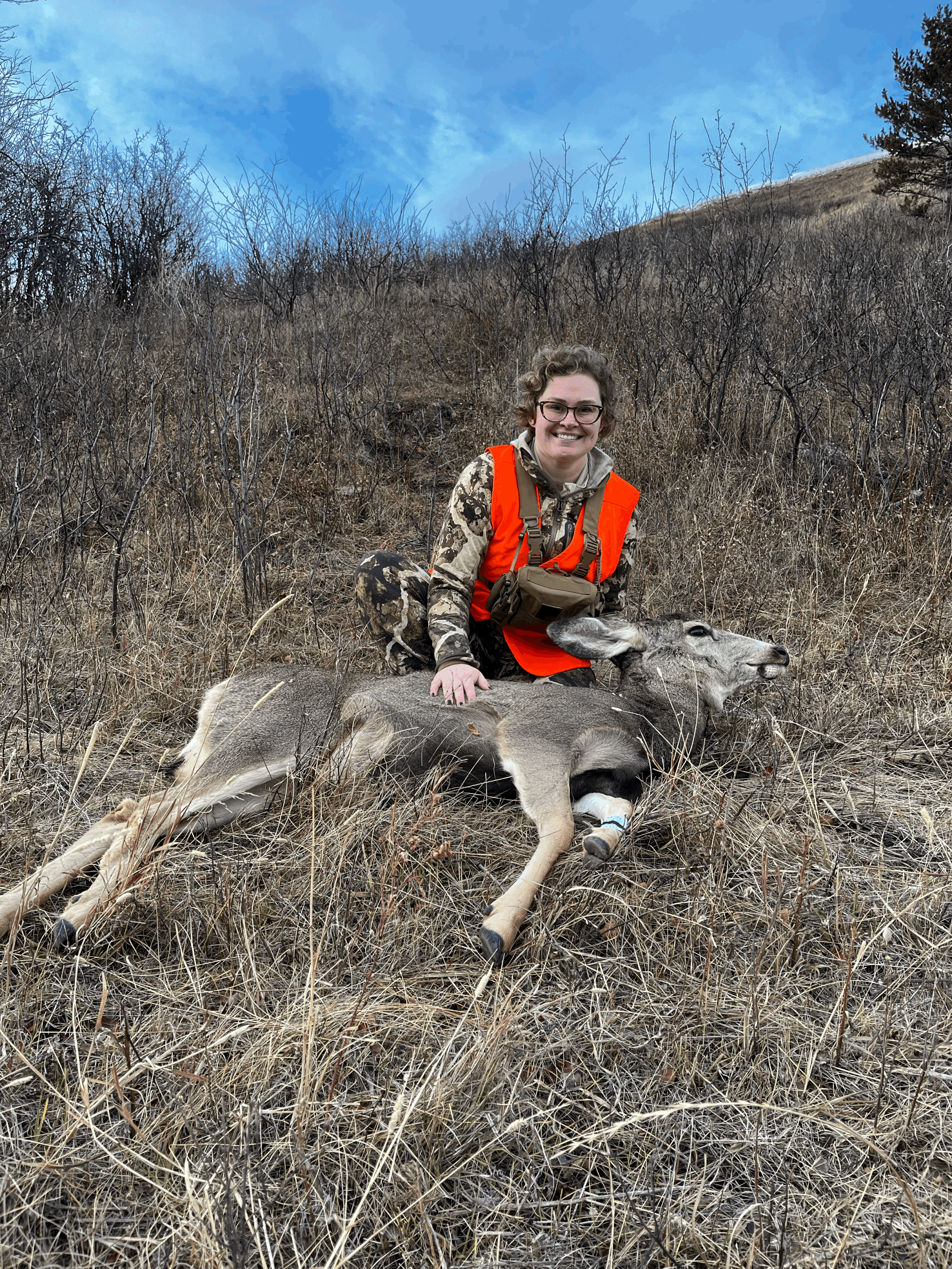
It wasn’t until I met my husband in 2018 that I picked up a rifle again and it would be three more years before I harvested my first deer seen in the picture above
.
With him, hunting became something different — not about ego or perfection, but about connection, sustainability, and healing.
It was the first time I saw hunting as a way to reclaim the parts of myself I’d buried.
To step back into the wild without fear — and with reverence.
Now, even with POTS, brain injury, significant hearing loss and auditory and visueal processing issues, visual impairment, and neuro fatigue — I still go.
Not to prove I’m capable.
But to remind myself that I still belong.
Because the wild didn’t abandon me — people did.
For the Child I Was and the Woman I Am
If I could speak to that 12-year-old girl now, I’d tell her:
You didn’t do anything wrong.
There were layers of things working against you.
You followed the rules.
And the silence that followed wasn’t your fault either.
You didn’t deserve the blame.
You didn’t deserve the shame.
You didn’t deserve to be alone in that pain.
And one day — you’ll find your way back to those sage-covered hills.
Not as the child who fell —
But as the woman who rose.
If this story speaks to anything you’ve carried alone — childhood trauma, chronic illness, neurodivergence, or the long road back to yourself — I hope you’ll stay with me, follow along @thechronicallyresilient.
And as always, Stay Resilient. ❤️🩹

No One’s Coming to Save You: The Day the Military Broke My Faith
I used to believe in the system — in the promise that if you served with integrity, the military would take care of you. But the day I got sick, everything changed. The uniform that once made me proud became a reminder of how quickly loyalty can be forgotten. No one came to save me — I had to save myself.
By Frankie — Disabled Air Force Veteran | Chronic Illness Advocate | Medical Nerd
I used to believe the Air Force was a family — that when things got hard, when life hit you sideways, your brothers and sisters in uniform would rally around you.
That we’d always take care of our own.
But the day my world crumbled around me, I learned the hard way that the military isn’t a family.
It’s a system.
One that will replace you in an instant, no matter how loyal, hardworking, or dedicated you’ve been.
The Diagnosis That Changed Everything
The day before it all happened, I was diagnosed with an arteriovenous malformation (AVM) in my brain — a rare and dangerous tangle of blood vessels that could rupture at any moment. One wrong movement, one bad day, and I could have a hemorrhagic stroke.
I remember sitting with that news, numb.
It felt like there was a bomb in my head, ticking.
I was in shock, unable to process the words “high risk for rupture.”
I didn’t cry. I didn’t even think.
I just froze — hovering somewhere between disbelief and terror.
The next morning, I went into work like I always did.
I was a medic — an Airman in direct patient care, responsible for the health and safety of others.
But as I walked through the clinic, it hit me that I didn’t feel safe taking care of anyone.
I wasn’t even safe in my own body.
I tried to hold it together through my morning patients, smiling like everything was fine — because that’s what we’re trained to do: push through, show up, be mission ready.
But inside, I was falling apart.
When my last patient left, I sat there for a moment, shaking.
I knew I couldn’t keep pretending.
So I did what I thought was right: I texted my NCOIC but not before looking around for him.
I told him something like,
“I’m not doing well, and I don’t think it’s safe for me to see patients or be at work today. I’ve seen all my morning patients, and I have someone who can cover my afternoon ones.”
It wasn’t perfect communication — I could barely form sentences — but it was honest, responsible, and sent before I left.
What I didn’t know was that he wouldn’t see it until later.
The Next Morning
When I walked into work the next day, my NCOIC was in a panic.
He’d just found out that my Flight Commander was trying to charge me with being AWOL and issue an Article 15 for leaving early.
My heart dropped.
I hadn’t done anything wrong — I had followed procedure, covered my patients, and told my supervisor I wasn’t safe to be in patient care.
I had just found out I had a ticking time bomb in my brain.
He wasn’t angry with me — he was overwhelmed by the situation and scrambling to manage the fallout.
But I was devastated.
I tried to explain what had happened — that I had texted him, that I physically and emotionally couldn’t face anyone that day.
I wasn’t defiant; I was in shock.
And still, I was the one being treated like I’d abandoned my duty.
Hearing that I was being accused of dereliction of duty sent me straight into another meltdown.
I left and went to Mental Health immediately.
I was scared, confused, and broken — punished for being human in a moment when I needed compassion the most.
Fighting for Myself
After that, I did what I always do — I fought back the only way I could.
I went to JAG, requested letters of character from the doctors I worked closely with, and gathered every piece of evidence showing my professionalism, reliability, and record.
My NCOIC barely spoke to me after that.
The same people who used to call me dependable, squared away, and trustworthy now treated me like I had failed them.
Eventually, the Article 15 was reduced to a Letter of Reprimand (LOR) — but the damage was already done.
I had never been reprimanded in my entire career.
That single piece of paperwork erased years of service, dedication, and sacrifice.
Because of it, I was later ruled ineligible for my Meritorious Service Award when I was medically retired — just four months after my diagnosis.
Isolation and Double Standards
What cut the deepest wasn’t just the paperwork — it was the hypocrisy.
Around the same time, my Flight Chief received her own life-threatening diagnosis.
Everyone rallied around her.
The unit bent over backward to support her recovery, to make sure she had time and space to heal.
But when I was the one in crisis — when I was fighting to process the fact that I could die at any moment — I was punished.
It was as if because my condition was rare and invisible, it somehow didn’t count.
I wasn’t seen as a person in crisis.
I was seen as an Airman failing to perform.
It broke something in me.
I realized that my worth to the Air Force was measured only by my output — not my humanity, not my service, not my sacrifice.
Just what I could give… until I couldn’t give anymore.
The Aftermath
Within four months, I was medically retired.
I don’t remember much of that time — just flashes of fear, confusion, and grief.
My career was gone.
My reputation as a good medic, a mentor, a leader — gone.
I kept asking myself: What did I do wrong?
All I did was get sick.
All I did was tell the truth.
And yet, I was punished for it.
What I Learned
It took years for me to find peace with what happened.
The truth is, sometimes no one is going to care.
No one is going to fight for you.
No one is coming to save you.
The military will replace you in an instant — but you can’t be replaced at home.
If you ever find yourself feeling used, dismissed, or broken by a system that was supposed to protect you, remember this:
Take care of yourself first.
Your worth isn’t measured by your rank, your performance, or your ability to keep pushing through pain.
I wish I had known that sooner.
Follow My Journey
If this story resonates with you — if you’ve lived through medical trauma, chronic illness, or the invisible fight to be believed — I invite you to walk this path with me.
You can follow my journey and advocacy work on Facebook and Instagram, where I share updates, insights, and reflections on life after survival @thechronicallyresilient
And as always,
Stay Resilient❤️🩹
From Life-Saving Surgery to Lifelong Consequences: My Fight for Answers
I share my story not just for awareness, but for anyone navigating life after Gamma Knife treatment. Brain radiation side effects and rare complications are rarely discussed openly — but they deserve to be. My journey is one of resilience, disability, and medical advocacy.
By Frankie
Disabled Air Force Veteran | Chronic Illness Advocate | Medical Nerd
“I never imagined the treatment that saved my life would take so much from me.”
If you’re here, maybe you’ve been where I’ve been — sitting across from doctors who once saved your life but now can’t explain what’s happening to your body. Maybe you’ve searched for answers in medical portals, scrolled through research articles at 2 a.m., or wondered if anyone would ever believe you again.
This is my story — of survival, loss, and a slow, painful rebirth into a life I never expected to live.
The Diagnosis That Changed Everything
In December 2018, I was diagnosed with a cerebral arteriovenous malformation (AVM) — a rare, tangled web of blood vessels deep in my brain. At the time, I was an active-duty medic in the United States Air Force, thriving in a high-pressure environment where precision and strength were part of my daily life.
When the diagnosis came, it felt like a betrayal by my own body.
I wasn’t the patient — I was the healer, the one others turned to in crisis.
My AVM was too large for open surgery, and on January 31, 2019, I underwent Gamma Knife stereotactic radiosurgery, a targeted form of brain radiation designed to destroy the AVM over time. The doctors were confident. I was told it was safe — precise, effective, controlled.
And it was. Gamma Knife saved my life.
But no one warned me about what else it might take.
“I went from fighting for the lives of others to fighting for my own.”
Within a week, I developed bilateral pulmonary emboli — blood clots in both lungs — triggered by my oral contraception. I survived that too, but my recovery was complicated and frightening.
A year later, my lungs failed me again. After months of shortness of breath and fatigue, I underwent a bronchoscopy and mediastinoscopy. The diagnosis: pulmonary sarcoidosis, a rare autoimmune disease that attacks the lungs and lymph nodes.
I was exhausted — but hopeful. I thought maybe this was just part of the healing process.
I was wrong.
When the World Went Silent
In September 2019, while hunting, I suddenly lost hearing in my left ear. One moment, I was aware of the world — the sound of my breath, my heartbeat and the frost crunching under my boots — and the next, there was silence. I was hiking the rolling hills of eastern Montana chasing antelope with my husband when suddenly there was a high pitched ringing in my left ear followed by that muffled hearing you get after firing a rifle without hearing protection. Except, my hearing never came back…
Eventually, I lost hearing in my right ear too and now I wear hearing aids to accommodate for some of my hearing difficulties.
Doctors couldn’t explain it. They called it idiopathic (no known cause) sudden sensorineural hearing loss, and every test came back inconclusive (allegedly). Actually, initially it was blamed on an extremely rare complication of sarcoidosis, neurosarcoidosis, or sarcoidosis. of the nervous system which can cause sensorineural hearing loss. This didn’t make sense though because my MRIs were not consistent with neurosarcoidosis.
With my medial background I naturally began doing my own research. That’s when I discovered studies linking Gamma Knife radiation to hearing loss and even scarier, cognitive impairment depending on which brain regions were affected. Before ever experiencing cognitive decline I reached out to my neurosurgeon and radiation oncologist through my MyChart portal messaging in December 2019, asking if my hearing loss could be related to my gamma knife surgery, looking for validation of what I already knew to be true.
They didn’t reply in writing. They called instead. I remember the words clearly — “That’s not possible.” My husband remembers the conversation too too.
But I knew something was happening inside my brain.
“It felt like my mind was slipping away, piece by piece.”
By 2021, my cognitive began impacting my life and I didn’t even realize it.
I forgot tasks, misplaced simple information, showed up wrong place wrong time, lost my train of thought mid-sentence.
I had always been sharp — the Air Force medic who thrived under pressure — and suddenly, I couldn’t function. I lost my job as a clinical receptionist, something that had once come naturally to me and theoretically should be super easy given my past profession. It devastated me, embarrassed me, brought about shame and deep unsettling fear for my future.
I wasn’t lazy. I wasn’t unfocused.
I had a brain injury — and no one believed me.
The Diagnoses That Finally Named My Reality
In 2022, I underwent a comprehensive neuropsychiatric evaluation. The results were both validating and devastating:
Major Neurocognitive Disorder
Autism Spectrum Disorder
ADHD
Non-Verbal Learning Disorder
Math Disability
During that same evaluation, the doctor asked a simple question that changed everything:
“Are you flexible?”
I showed him — the bendy joints, the stretchy skin I’d always joked about as a kid. His eyes widened. That led to a referral and, finally, a diagnosis of Ehlers-Danlos Syndrome (EDS), a genetic connective tissue disorder that explained my whole life — my chronic pain, neurodiversity, fatigue, and joint instability.
“Everything finally had a name — but no one had warned me any of this could happen and even worse they wouldn’t admit it could have happened.”
By 2023, a new MRI confirmed what I already felt: stable but permanent brain damage — areas of encephalomalacia and gliosis, meaning my brain tissue had been injured and scarred. It was described as a “chronic treatment effect.”
The damage is stable.
But it’s irreversible.
In June 2024, after years of monitoring, my AVM had finally shrunk enough to be surgically removed. The resection was successful, but I temporarily lost left-sided vision, which slowly returned after months of recovery as well as more white matter brain damage.
It felt like every victory came with a loss, although I'd do it all over again, to save my life.
Living With the Aftermath
Today, my daily life is a careful balancing act.
I live with permanent cognitive and sensory deficits — and a long list of conditions tied to Ehlers-Danlos Syndrome, including:
POTS (Postural Orthostatic Tachycardia Syndrome)
MCAS (Mast Cell Activation Syndrome)
Chronic dehydration and hypotension
Gastroparesis and unintentional weight loss
Chronic pain, fatigue, and insomnia
Spinal instability with bulging discs and synovial cysts
“Every day is survival disguised as routine.”
I rely on structure and technology to function:
AI tools to help me write and remember,
Shared calendars, reminder apps and detailed notes track my days an responsibilities,
and the unwavering support of my husband and mother to help me stay on track and accomplish what I need to day to day.
I undergo IV hydration therapy multiple times a week to manage chronic dehydration, POTS and hypotension.
I carefully monitor my diet and weight just to maintain enough stability to take my ADHD medication safely.
Every aspect of my existence is managed, measured, and monitored.
The Fight for Answers
I have spent years researching, documenting, and trying to understand how my brain — the same one I once trusted to heal and care for others — became the source of my greatest challenges.
When I reached out in 2019, I wasn’t looking to blame anyone. I was scared. I just wanted to understand.
But my questions were dismissed and I was denied timely and thorough diagnosis, treatment and resources that could have made the transition from able to disabled a lot less traumatic. I was made to feel it was “all in my head”, that I was creating stories.
Now, after years of rehabilitation following the triggering of my chronic illnesses, I’m finally strong enough. mentally and physically to ask again and to fight for the truth.
In November 2025, I’ll meet with a neurologist who is willing to review my MRIs and explore the possible connection between my Gamma Knife treatment and my neurological and sensory disabilities.
It will be the first time any doctor has truly taken my concerns seriously.
“Healing doesn’t just mean surviving — it means being heard.”
I’m not seeking sympathy — I’m seeking truth and understanding.
Because I believe every patient deserves to know the full range of possible outcomes before consenting to treatment as well as what their resources are for recovery, support and accommodation if the unthinkable were to happen.
I believe every medical record should reflect a patient’s communication attempts, even when the answers are uncomfortable or are the result of care that was meant to save their life.
And I believe that “rare complications” should still be discussed — not dismissed.
What I Want Every Patient to Know
If you’ve ever been dismissed, told “it’s not possible,” or made to feel like your pain is an inconvenience — please hear me: you are not alone.
Document everything.
Ask questions, even when it makes people uncomfortable.
Request copies of your imaging, lab work, and communications.
And if your instincts tell you something is wrong — trust them.
Because you are the one living in your body.
You are the one carrying its history.
“I am not broken — I am disabled. And I am still here.”
I am forever grateful for the surgery that saved my life. But I wish I had been told the whole story — the possibilities, the risks, and the lifelong adjustments that might follow.
I’ve had to grieve the person I was — the Air Force medic, the quick thinker, the multitasker.
Now, I am someone new: slower, softer, but stronger in ways I never expected.
This is my story — not of loss, but of reclamation.
Of finding strength in limitation.
Of turning silence into testimony.
And if you’ve made it this far, please know — your story matters too.
💬 Follow My Journey
If this story resonates with you — if you’ve lived through medical trauma, chronic illness, or the invisible fight to be believed — I invite you to walk this path with me.
You can follow my journey and advocacy work on Facebook and Instagram, where I share updates, insights, and reflections on life after survival.
➡️ @thechronicallyresilient
And as always, Stay Resilient ❤️🩹
Grieving Myself: Living with Dementia as a Young Adult
I’m grieving the person I used to be — the medic, the multitasker, the woman who could remember every detail. After losing my hearing and cognitive function following Gamma Knife radiation, I’ve had to rebuild my identity while living with invisible disabilities the world can’t see. This is my story of autistic burnout, brain injury, and the fight to find purpose in the aftermath.
By Frankie
Disabled Air Force Veteran | Chronic Illness Advocate | Medical Nerd
I’ve been really struggling lately — mentally and physically. My fatigue is worse, my pain is worse, my memory and focus are worse, and even my hearing and ability to process sounds is deteriorating. I’m completely burnt out, and I felt like people needed to hear the real thoughts that constantly plague my mind. I think I’m going into Autistic burnout.
As an Autistic person, I have delayed processing, which means when something happens — happy, sad, or traumatic — I don’t process it at the time. Sometimes it hits minutes later, hours later, days later… or even years later.
The Diagnosis That Changed Everything
I was diagnosed with dementia at 26, but by then, my health had been declining for a few years and I had gone from leading in a high pressure medical environment to being fired for my limitations working as a clinical receptionist... Unfortunately the diagnosis itself fell by the wayside amid the chaos because I simply didn’t have the capacity to fight for it at the time. I was too scared, too tired, too sick.
I lost the version of me who could work, thrive in my special area of interest — medicine. I was sharp, organized, confident. Now, I’m a stay-at-home mom, homeschooling my daughter, and focusing on therapy and medical appointments. I have new purpose — but the grief is still real. Sometimes I wish people understood that losing your hearing or losing your ability to function cognitively feels as if someone has just amputated your arm. I sometimes wish there was a visible sign or indication to prove that yes, I am disabled, but would be insane. I shouldn’t have to prove anything. People should just be more capable of compassion, understanding and empathy. Full stop. Understand us. Accommodate us. Accept US. Just as we accept everyone else.
Coping with Hearing Loss & Cognitive Decline
Along with dementia, I lost my hearing and my ability to process sounds like everyone else. I have to wear hearing aids, and despite using calendars and reminders obsessively, I sometimes show up on the wrong day, at the wrong time, or late.
It’s not just embarrassing — it’s guilt-inducing, because I know my struggles inconvenience others. I’ve always been dependable and punctual, but now I can’t always be the person I used to be.
Phone conversations or any conversation really are extremely difficult because not only do I have hearing loss in both ears so it’s hard to hear on the phone or in a crowded room, I also have auditory processing disorder and memory issues so written communication is honestly the best way to communicate with me if you want me to remember the message you’re trying to get across.
Even on “good” days, I am still sick, still disabled, and still struggling to function in ways most people take for granted.
Anger, Research, and the Medical Response
After my diagnosis, no one cared to investigate the cause of my cognitive changes and hearing loss. I was 26, and no one thought that was alarming so I did what I always do: I hit the research hard.
What I found shocked me: Gamma Knife radiation can cause major neurocognitive disorder (dementia) and hearing loss due to tissue damage. Yet, the medical community refuses to admit it or even investigate it. If I had a confirmed cause, I could accept myself the way I do with my autism. I could explain myself and stop people from assuming, “You just have a lot going on.” This is not the same.
Grieving Myself
I feel like I’m grieving myself — the person I thought I would be. I look back on my military career as a medic and conversations with the doctors I worked with. One of them said, “Sgt, why haven’t you gone to medical school? You’d be an amazing physician.” That memory rips my heart out. I will never be who I wanted to be.
Even as I’m learning to embrace the new me, I am still in deep mourning — a grief so profound I can’t even put it into words. The person I was, the life I imagined, the abilities I had… they’re gone, and some days that loss feels unbearable. It feels like part of me died.
Living with Invisible Disability
What makes this journey almost intolerable is the dismissal from people who say, “Well, you look and sound great!.” While this is not ill intended, it’s harmful because my struggle is invisible. They see a smile and assume I’m fine, but this has been life altering for me.
But I’m still here. I’m still fighting. I’m still showing up — even if no one sees the battles I fight inside. Chronic illness and invisible disability are lonely, but I refuse to stop trying.
Finding Purpose & Resilience
I’m learning, slowly and painfully, to embrace this new version of me. I may not be the person I once was or that I planned on being but I’m still capable of love, resilience, and showing up in my own way. I have a lot to give to the world.
If my story resonates with you — whether you’re navigating chronic illness, brain injury, or invisible disability — you are not alone.
If you don’t live with any of this and are just here to learn then I encourage you to follow me on YouTube, Facebook and Instagram to learn more!
And please, reach out! I love swapping stories and bouncing ideas off of each other to help advocate for our health.
And as always, stay resilient ❤️🩹