Two Operating Systems, One Brain: Living with Both Autism and ADHD
Autism tells me not to change a thing. ADHD tells me to change everything. I live somewhere in between — building a life that honors both my need for comfort and my craving for newness. I’m not broken for needing both. I’m just running two powerful programs that don’t always play nicely together.
By Frankie — Disabled Air Force Veteran | Chronic Illness Advocate | Social Scientist
Sometimes it feels like my brain runs on two competing operating systems — one built for structure, the other for chaos. One that craves predictability, and one that thrives on spontaneity. One that analyzes everything down to the molecular level, and one that forgets what I was doing mid-sentence because a bird flew by the window.
That’s what it’s like living with both Autism and ADHD — what many of us affectionately call AuDHD.
Before I Knew the Name for It
For most of my life, I just thought I was “too much” or “too intense.”
Too organized yet too distracted. Too sensitive yet too blunt. Too focused yet too forgetful.
As a kid, I was the one color-coding my school binders but losing my pencil three times a day. I loved rules — until they didn’t make sense. I’d hyperfixate on a project, pouring every ounce of energy into it for days, only to crash so hard afterward that I couldn’t function. Teachers saw potential, but not the exhaustion underneath.
Later, in the military, that duality became both a strength and a curse. I was laser-focused when I needed to be — calm in chaos, efficient, precise — but behind the scenes I was burning out. My brain was running 24/7 diagnostics, processing every sound, every tone of voice, every possible consequence. I didn’t know it then, but what I was calling “overthinking” was actually autistic processing, and what I thought was “just me being scatterbrained” was ADHD demanding dopamine and novelty.
The Diagnosis That Finally Made It Make Sense
It took years — and a lot of self-reflection — before I discovered that I was both Autistic and ADHD. It didn’t come from one defining test or moment, but from connecting patterns across decades of lived experience.
When I finally received both diagnoses, it felt like someone handed me the user manual for my own brain. For the first time, I wasn’t broken — I was simply wired differently.
But learning that you’re AuDHD is one thing. Learning to live as an AuDHD adult — to build systems around your wiring — is a whole different journey.
The Constant Push and Pull
Autism grounds me in routine. It gives me a deep love of structure, order, and precision. I find peace in patterns and predictability — in knowing what’s coming next.
ADHD, on the other hand, thrives on movement — the thrill of novelty, the spark of curiosity, the endless search for stimulation. It’s the part of me that wants to try five new projects at once, reorganize my workspace at midnight, and somehow forget where I put my coffee in the process.
Together, they form a tug-of-war that never really stops. My autistic side craves calm; my ADHD side gets bored by it. My ADHD side seeks excitement; my autistic side gets overwhelmed by it. It’s like having one foot on the gas and one on the brake at the same time.
And yet, in a strange way, that internal conflict is also what makes me, me.
The In-Between Space
Being both isn’t just a balancing act — it’s an identity that often feels invisible.
Sometimes it feels like I’m too autistic for ADHDr’s and too ADHD for Autistic people. The struggle is real. I live in the overlap — where structure and chaos collide, where community feels close but not quite aligned.
In ADHD spaces, I’m the one talking about sensory overload and needing silence — while others blast music and brainstorm out loud. In Autistic spaces, I’m the one interrupting myself mid-sentence because I had an idea I have to share before it escapes. Both sides are home, and yet neither fully fits.
It can be isolating, trying to explain how I can be both hyper-organized and completely disorganized, deeply empathetic yet socially drained, brilliant under pressure yet sometimes paralyzed by starting small tasks. But in this in-between space, I’ve also found people who get it. Other AuDHDers who live at the same intersection of curiosity, chaos, and clarity.
How It Shows Up in Everyday Life
My days are a constant dance between management and surrender.
I live by lists, calendars, and alarms — not because I’m Type A, but because if I don’t, everything collapses. I set reminders to eat, to rest, to move, to breathe. Some days it all works beautifully. Other days, my brain throws the whole system out the window and says, “We’re doing THIS now!”
There are times when I hyperfocus so deeply I forget the world around me — writing for hours, creating content, or researching a topic until my eyes blur. Then suddenly, I crash. My body demands stillness, my brain goes foggy, and the sensory overload hits like a wave.
Relationships can be tricky too. I love deeply and communicate intensely — but sometimes I miss social cues, overexplain, or get lost in my own thought spirals. I’ve learned to be honest about that:
“Hey, I’m not ignoring you, my brain just took the scenic route.”
And while masking used to feel like survival — trying to appear neurotypical so others wouldn’t misunderstand me — I’m learning now that unmasking is freedom. I don’t need to apologize for how my brain works. I just need environments that allow it to thrive.
The Strengths That Come From Both
For every challenge, there’s a mirror of strength.
My Autistic brain helps me see details others overlook — patterns, connections, inconsistencies. My ADHD brain helps me dream big and act fast. Together, they let me innovate, empathize, and create in ways I couldn’t if I were just one or the other.
I can take an abstract idea and bring it to life. I can organize chaos and find beauty in systems. I can feel emotions deeply and communicate them in ways that resonate.
That’s not to say it’s easy — there are still days of shutdowns, burnout, and sensory overload. But I’ve learned that those moments aren’t failures; they’re signals. My brain saying, “I’ve done enough. Time to rest.”
Learning to Work With, Not Against, Myself
I used to think I had to choose — to be the calm, structured version of me or the spontaneous, creative one. I thought one part had to win, that I couldn’t be both without constant friction.
Now I know better. I build routines that flex. I plan for distraction. I forgive myself for the days when focus is impossible, and I celebrate the ones when I’m on fire.
Some people think “balance” means achieving perfect control. For me, balance means permission — permission to ebb and flow, to rest and restart, to be both brilliant and scattered, both grounded and impulsive.
Living with Autism and ADHD isn’t a contradiction. It’s a spectrum within a spectrum — a reminder that the human brain was never meant to fit neatly into boxes.
Acceptance, Community, and Resilience
Since embracing my AuDHD identity, I’ve met others like me — people who’ve spent a lifetime feeling “almost understood.” We trade stories, share coping tools, laugh about our collective chaos, and remind each other that we’re not broken; we’re just different.
I’ve learned to build a life that supports both operating systems. To rest when I’m overstimulated, to feed my curiosity without guilt, to use movement when I can’t focus, and silence when I can’t think.
If you’re someone navigating the same intersection, know this: you’re not alone. There’s no right way to be both. You don’t have to justify your contradictions — they’re part of your brilliance.
Because sometimes, two operating systems can create something extraordinary — if you give them both the space to run.
✨ If this resonates with you, please follow along at @thechronicallyresilient — and as always,
Stay Resilient ❤️🩹
When the World Is Too Loud Inside: Autism, cPTSD, and the Quiet Battle Within
Learning to stay — even when the world is too loud inside.
By Frankie — Disabled Air Force Veteran | Chronic Illness Advocate | Social Scientist
⚠️ Trigger Warning: Suicidal Ideation
The Noise No One Else Hears
There’s a kind of noise that doesn’t live outside you — it hums beneath your skin.
It’s the sound of a world that’s too bright, too loud, too fast — and a brain trying to process it all without breaking.
For years, I thought that noise was normal. The constant vigilance, the exhaustion after every conversation, the invisible weight pressing on my chest. I learned to smile through it, to mask, to blend. I learned to look “fine” even when my mind was screaming for quiet.
Autism taught me how to survive a world not built for me.
Trauma taught me how to fear it.
Complex trauma taught me how to disappear inside it.
When Safety Isn’t Safe
People talk about PTSD like it’s only flashbacks or nightmares. But for many of us, trauma didn’t come from one moment — it came from many.
My life has carried layers of trauma:
An abusive childhood that taught me to walk on eggshells.
Military sexual trauma that fractured my sense of safety in my own body.
Domestic abuse that twisted love into something unrecognizable.
Medical trauma that reminded me again and again that being believed is a privilege, not a guarantee.
Each wound carved its own echo into my nervous system, compounding into what clinicians call Complex PTSD — cPTSD.
But to me, it just feels like never being able to fully exhale.
And when you’re autistic, that trauma hits differently.
Our brains are estimated to process up to 42% more sensory and contextual information than the average brain. While others see a room, we experience the hum of the lights, the weight of the air, the tension behind every word. The world is louder, brighter, faster — and it doesn’t stop.
So even without the big traumas, life itself is already a battlefield. Add years of abuse, betrayal, and medical harm, and the result is a nervous system that’s always bracing for impact.
It’s no wonder that so many autistic people live in a constant state of trauma adaptation.
We’re not fragile — we’ve simply been asked to carry more than most people can comprehend.
The Loneliness of Being Misunderstood
Masking is supposed to keep you safe. But over time, it becomes another kind of prison.
You forget what your real voice sounds like — or whether it would even be heard if you used it.
I learned to hide everything that didn’t make sense to others: my intensity, my sensitivity, my shutdowns. I learned to apologize for the ways my brain processes the world. I learned that the more I explained, the more misunderstood I became.
And that’s when the silence started to sound seductive.
It wasn’t that I wanted to die. It was that I didn’t know how to keep living in a world that constantly told me my way of existing was wrong.
Suicidal ideation doesn’t always look like wanting to end your life — sometimes it’s just wanting to pause it. To find a way out of the endless noise, guilt, and fatigue.
Research shows autistic people are up to nine times more likely to die by suicide than the general population.
Autistic women and those with cPTSD face the highest risk, not because we lack resilience — but because we’ve been chronically invalidated, over-stimulated, and abandoned by the systems meant to help.
When the world punishes you for existing authentically, it’s not that you want to die — it’s that you want the pain of being unseen to stop.
The Ache of Connection
Relationships are one of the hardest parts of being autistic.
I’ve spent my life trying to love people in the way that feels truest to me — deeply, consistently, and with everything I have — only to watch them drift away as if my love were too heavy to carry.
I never quite feel like I fit anywhere. I can be surrounded by people and still feel like I’m standing behind glass.
Over time, I’ve started to believe I’m unlovable — that something about me repels closeness, even when all I want is to connect.
People I thought loved me, people I poured myself into, seem to fade away.
The misunderstanding — the gap between what I mean when I say I care and what others hear — is like a language barrier I can’t seem to cross.
To me, love means showing up. It means consistency, honesty, loyalty.
But for many, love seems to mean performance — the right words, the right tone, the right gestures.
And that deviation leaves me feeling like I’ve come from another planet. Like I’m fluent in a language no one else wants to learn.
Some days, I feel like an alien — watching a species I’ll never quite belong to, loving them fiercely anyway.
The Lost Childhood of the Masked
Looking back, I realize that autistic children rarely get the chance to truly be children.
While others were discovering who they were, I was studying how to be someone else.
Every social cue, every tone of voice, every reaction — I analyzed them like survival manuals.
By the time most people start forming a sense of identity, we’ve already built ours around avoidance:
Don’t be too loud.
Don’t be too honest.
Don’t be too much.
We become experts at pretending long before we ever get to just be.
And by adulthood, many of us realize we have no idea who we are — only who we’ve been told to be.
That’s where I am now: learning who I am for the first time.
Unlearning the rules that kept me safe but small.
Reclaiming the childhood I never got to live — the one spent observing instead of belonging.
Burnout, Not Brokenness
What many doctors mistake for depression in autistic people is often burnout — and they are not the same thing.
Depression implies chemical imbalance, something wrong within us. Burnout, though, is a natural response to a world that constantly overwhelms, misunderstands, and demands more than we can give.
We’re not broken. We’re exhausted.
We’re not sad without reason — we’re grieving a world full of injustice, contradiction, and tyranny.
Our so-called “depression” is often a moral and sensory rebellion — a deep awareness that something is wrong out there, not in here.
It’s the weight of compassion without relief. It’s empathy without rest.
It’s waking up every day to systems that silence, exploit, and discard — and still choosing to keep trying anyway.
Autistic burnout isn’t a flaw in character. It’s evidence of endurance in an unrelenting world.
Belonging, Letting Go, and Becoming
The older I get, the more I understand the shape of loneliness.
It’s not just being alone — it’s wanting to belong so deeply that it hurts.
For most of my life, I chased belonging like it was oxygen. I wanted to be understood, accepted, chosen — to find my place among people who wouldn’t ask me to shrink. But over time, I learned that sometimes peace is found not in being accepted by others, but in accepting myself.
I’ve started to find solace in solitude — in being comfortable with who I am, even if that means walking alone.
I’ve learned to let people go when they can’t reciprocate my energy or meet me in my depth.
I still love them — just from afar.
Instead of begging to belong, I’m focusing on becoming:
Becoming the woman I needed when I was a child.
Defining my morals.
Choosing who I want to be.
And raising my neurodiverse children to live freely — to know they never have to hide or shape-shift to be worthy of love and acceptance. To never feel like things would feel better if they just didn’t exist.
My goal isn’t to teach them to fit in.
It’s to teach them to stand tall in exactly who they are — no boundaries, no masks, no shame.
The Rebellion of Authentic Minds
Many of us with autism don’t believe in hierarchy, power games, or the unspoken social rules that demand we “know our place.”
Our brains are wired for truth — not control. For justice — not dominance.
That’s why so many of us resist systems that exploit, manipulate, or silence. We don’t rebel because we’re difficult; we rebel because we see clearly what others have been taught to ignore. We reject conformity because it costs us our peace, our integrity, our very sense of self.
That same rebellion — that refusal to perform — is what helps us survive trauma, too.
It’s what drives our advocacy, our empathy, our storytelling. It’s what keeps us reaching for authenticity in a world that keeps demanding that we mask.
Learning to Stay
Healing didn’t happen because I stopped breaking. It happened because I stopped hiding the broken parts.
I began to understand that my cPTSD wasn’t a weakness — it was a survival mechanism that kept me alive in impossible conditions.
That my autistic brain wasn’t defective — it was doing exactly what it was designed to do: protect me.
I started writing again. Sitting in the sun. Breathing through the sensory storms and embracing my meltdowns instead of apologizing for them.
I found peace not by silencing the noise, but by learning its rhythm — by letting myself exist as I am, not as the world wanted me to be.
And with all of that being said, it’s not surprising that my college education is in Sociology.
After a lifetime spent trying to understand people — their behaviors, their hierarchies, their contradictions — I now study the very systems that shaped me.
It’s both healing and haunting to recognize the patterns from the outside looking in: to see how structures that were supposed to protect us often perpetuate the pain instead.
But this time, I’m not studying people to survive them.
I’m studying them to understand how to change the system — and maybe, how to change myself.
If You’re There Too
If you’re in that quiet battle — the one no one sees, the one where you wonder if you can keep going — please know this: you are not a burden.
Your exhaustion is valid. Your confusion is valid. Your survival is proof of strength.
There’s no shame in needing help. No weakness in needing rest.
Stay. Breathe. Reach for the light, even when it feels far away. You are not too much — the world has simply been too small for what you carry.
You are never alone in this.
If this resonates with you please follow my journey @thechronicallyresilient.
And as always, Stay Resilient ❤️🩹
When Words Don’t Translate: Understanding Autistic Communication
Autistic communication isn’t broken — it’s honest.
It’s direct, layered, and rooted in sincerity.
For people like me, connection doesn’t always come through tone or body language — it comes through written words, truth, and intention. This isn’t about attention or likes. It’s about sharing my internal world so others like me can feel a little less alone.
Read When Words Don’t Translate: Understanding Autistic Communication in Blog 2: Autistic Diaries on thechronicallyresilient.com.
And as always, Stay Resilient ❤️🩹
By Frankie — Disabled Air Force Veteran | Chronic Illness Advocate | Social Scientist
People heard the words I said, but not always the meaning. I’d replay conversations in my head, wondering how something said with love came out sounding cold, or how silence meant indifference when it really meant careful processing.
For years, I thought I was broken — too blunt, too literal, too intense. I learned to script my sentences, to soften my truth, to smile when I didn’t understand the joke. But masking that way came at a cost: I lost my voice trying to sound like everyone else’s.
Autistic Communication Isn’t a Flaw
Autistic communication isn’t a flaw in social ability — it’s a difference in wiring, rhythm, and intent.
Where neurotypical language often revolves around implied meaning and social choreography, autistic communication thrives on precision, sincerity, and shared focus. We speak to connect, not to perform.
For many of us, words are weighted — they carry texture, pattern, and truth. We might communicate through patterns, through written words, through parallel play, or even through silence. Our language isn’t missing something; it’s simply built differently.
The Myth of Lack of Empathy
One of the most painful misconceptions about autistic people is that we lack empathy.
That couldn’t be further from the truth.
Many of us feel so deeply that it can be overwhelming. We notice micro-expressions, shifts in tone, the smallest change in someone’s energy. Sometimes we feel others’ emotions so strongly that it’s hard to know where theirs end and ours begin. But the way we express empathy doesn’t always fit what the world expects.
When someone we love is hurting, we might offer solutions instead of comfort because our brains jump straight to fixing the problem. Or we might go quiet — not because we don’t care, but because we’re processing every word carefully to make sure we respond authentically.
In the military, that difference in expression often made me feel misunderstood. My directness was mistaken for coldness, my silence for defiance, my honesty for disrespect. But beneath every blunt statement was a genuine desire to help, to protect, to connect in a world that often felt too loud and too fast.
Autistic empathy isn’t absent — it’s just a different dialect of the same emotional language. One built on truth over performance, presence over pretense, and understanding over small talk.
What Autistic Communication Actually Looks Like
Autistic communication doesn’t always fit inside the social “scripts” most people expect.
It’s not small talk or polite filler — it’s intentional, sincere, and often deeply focused. When we communicate, we’re not trying to impress; we’re trying to connect through truth, accuracy, and shared meaning.
For me, that means saying exactly what I mean — without the softeners or social detours that neurotypical people often use. I don’t nuance things. I speak the truth as I see it, even when it’s uncomfortable, because authenticity feels safer than pretending.
Because of hearing loss, auditory processing challenges, memory issues, and cognitive changes after brain injury, phone conversations are especially difficult for me. I can miss pieces of dialogue or lose context entirely, which makes written communication far more effective. Writing gives me time to process, reflect, and ensure that my message matches my intent.
Still, there are times when even a message sent with love and concern is perceived as “too much,” “too blunt,” or “overstepping.” But to me, truth isn’t harsh — it’s grounding. It’s how I build trust.
Autistic communication can be direct, pattern-based, or written — but above all, it’s rooted in sincerity. We may not speak the same social dialect, but our intention is rarely ever to harm; it’s to connect honestly, without masks.
When Communication Breaks Down
The hardest part about communicating differently is knowing your heart’s in the right place — and still being misunderstood.
I can spend hours choosing my words carefully, making sure every sentence reflects both truth and care, and somehow it still lands wrong. People hear tone before they hear intent. They interpret directness as hostility, silence as avoidance, or passion as anger.
In the military, that misunderstanding carried real consequences. I was expected to communicate within a strict chain of command — clear, concise, and respectful — but even when I followed those rules, my straightforwardness was often read as insubordination. Later, in friendships, that same honesty was seen as “too much” or “too intense.” I’ve learned that some people want comfort, not clarity — and for someone like me, that’s an impossible ask.
When communication breaks down, it’s rarely about the words themselves. It’s about the translation gap between two very different processing systems.
Neurotypical communication tends to rely on subtle cues, body language, tone, and social intuition.
Autistic communication depends on patterns, logic, and sincerity. Both are valid, but when they collide without understanding, it can lead to deep emotional fallout on both sides.
For me, it often results in guilt and exhaustion — that crushing feeling of,
Still, I remind myself: communication isn’t just about being understood — it’s about staying true to who you are while finding ways to bridge the gap.
Learning to Bridge the Gap
I’ve spent years trying to find balance — the space between speaking my truth and being understood.
For a long time, that meant masking. I’d rehearse conversations, soften my delivery, or rewrite messages three times before sending them. It wasn’t about deception; it was survival. But over time, masking chipped away at my confidence.
Learning to bridge the gap hasn’t been about changing who I am — it’s been about learning when and how to clarify my intentions. Sometimes that means saying, “I’m not trying to be harsh; I just care deeply.” Or explaining ahead of time,
I’m also learning the importance of asking for permission before starting a difficult conversation — not because I’m afraid to speak, but because I’ve learned that sometimes the other person isn’t ready to hear it.
Miscommunication or a lack of communication can easily turn good intentions into conflict. Asking, “Is now a good time for a serious talk?” gives both of us a chance to be emotionally ready and prevents misunderstandings before they start.
We work so hard to accommodate neurotypicals — to make them comfortable in our presence, to adjust our tone, our body language, and even our natural rhythms so they don’t misread us.
I don’t think it’s too much to ask that others try to meet us halfway — to communicate with us in a way that works for us, too. We just want understanding, acceptance, and accommodation.
When something happens to a non-autistic person — when they experience a crisis or receive life-changing news — it’s taken seriously. There’s compassion, urgency, support.
But when an autistic person is in crisis — when we’re facing a life-threatening diagnosis or, worse, a life sentence like dementia — it’s often minimized or misunderstood. Our pain or crisis doesn’t seem to register the same way, even though it’s every bit as real.
All we’re asking for is to be heard with the same empathy that’s so easily given to others.
Why I’m Writing This
I’m not chasing followers, likes, or validation. I’m not here to make public statements about my truth as a weapon to expose or humiliate anyone close to me.
I’m writing this because these words have lived in my body for years — building pressure behind every misunderstood moment, every conversation that went sideways, every time I felt too much and said too little.
I’m writing this to share my internal world — to make sense of it, and to open it to others who might be living quietly in their own. I want to meet people who communicate like I do, who love differently but deeply, who have spent their lives trying to explain themselves in a world that keeps asking them to translate.
Because truthfully?
I’d sure like to feel a little less fucking alone.
This isn’t about performance. It’s about connection.
It’s about reminding every autistic, neurodivergent, chronically ill, or misunderstood person out there that your voice matters — exactly as it is.
It’s layered, patterned, and deeply human. It may not always fit the world’s expectations, but it’s ours — and it deserves to be understood on its own terms.
I’ve spent most of my life trying to bridge the gap between worlds — between neurotypical and autistic, between what I mean and what people hear. What I’ve learned is that the bridge can only stand if both sides are willing to meet in the middle.
If you’ve ever felt misunderstood, unheard, or “too much,” I hope this makes you feel a little less alone.
Your way of communicating, connecting, and existing is valid — and it’s beautiful in its truth.
Thank you for reading, for listening, and for being willing to understand.
✨ If you’d like to keep walking this journey with me — through autism, chronic illness, healing, and resilience — you can find me on Instagram and Facebook at @thechronicallyresilient.
And as always,
Stay Resilient ❤️🩹
Love with an Autistic Heart: Learning to Be Understood, to Set Boundaries, and to Love Myself First
Loving as an autistic person means feeling deeply, sometimes painfully. This is my story of being misunderstood, rebuilding, and learning self-acceptance.
By Frankie — Disabled Air Force Veteran | Chronic Illness Advocate | Social Scientist
“Autistic love isn’t loud. It’s deep, loyal and sometimes misunderstood.”
The Quiet Weight of Feeling Deeply
For most of my life, I’ve loved with my whole nervous system.
Every connection, every friendship, every relationship I’ve ever had has lived somewhere beneath my skin — pulsing, sensory, almost electric. I notice everything. The pauses in a conversation. The way someone’s tone changes mid-sentence. The subtle cues of distance that other people might miss.
That’s the thing about loving with an autistic heart — it’s not casual. It’s never halfway. When I love, I catalog every detail, every moment, and I hold on tightly. But what I’ve learned — sometimes painfully — is that not everyone loves that way in return.
When Love Hurts: The Ache of Being Misunderstood
Recently, I had a tough conversation with one of the few people I truly believed accepted me fully — even with my new disabilities, limitations, and the ways my brain now works differently.
It started as an honest attempt at connection. I wanted to understand why the friendship had grown distant, why communication had become one-sided. I thought I was being direct, respectful, open. Instead, it turned into anger. They accused me of being critical, judgmental, hurtful.
I left that conversation gutted.
I’m tired of being misunderstood.
Tired of loving fully and receiving a fraction of that love in return.
Tired of being an afterthought — of giving so much emotional labor that I end up depleted and unseen.
That moment reminded me of every time I’ve been punished for being honest. Every time someone mistook my transparency for coldness or my silence for disinterest. But what they didn’t see was the overwhelm behind my words — the thousand invisible calculations happening in my head just to keep the interaction afloat.
The Autistic Way of Loving
Autistic love is often quiet, but it’s not weak. It’s detail-oriented, deeply loyal, and fiercely protective. We love through actions, through consistency, through showing up.
We memorize (if we don’t have a brain injury impairing our memory like I do), your favorite snacks. We remember the songs you hum when you’re anxious. We replay conversations in our minds for days, trying to understand what we might’ve missed.
“I don’t love halfway — I either love with my whole nervous system, or not at all.”
But the world doesn’t always recognize that kind of love. In a society that celebrates spontaneity, we’re the ones who crave stability. In a culture that rewards small talk, we speak in depth. That mismatch often leaves us loving loudly in a language most people can’t hear.
Communication, Shutdowns, and Masking
For years, I thought the only way to be loved was to make myself easier to understand — to mask my needs, quiet my honesty, dilute my intensity.
In relationships, that meant saying “I’m fine” when I wasn’t. It meant hiding sensory overload behind a forced smile. It meant apologizing for being “too sensitive” when my body was simply responding to too much noise, too much light, too much everything.
There were times in my marriage when I shut down completely.
When I couldn’t speak, couldn’t make eye contact, couldn’t explain the storm inside me. To someone neurotypical, that can look like disinterest or withdrawal — but in reality, it’s the opposite. It’s my system protecting itself from breaking entirely. Unfortunately, I also had another layer of difficulty, dementia and hearing loss from a brain injury following gamma knife brain surgery.
It took years for us — for me — to understand that love can exist in stillness, too. That needing silence isn’t rejection. That boundaries aren’t barriers.
Rebuilding Connection and Learning Boundaries
When my husband and I made the intentional decision to rebuild our relationship, we didn’t start from where we were — we started from scratch.
We learned each other’s communication styles. We stopped trying to fix or correct each other and started observing instead. We created new rules for safety in conflict — no yelling, no walking away mid-conversation, time-outs when either of us was overstimulated.
For the first time, I stopped apologizing for needing things like structure, reassurance, or quiet. And he stopped taking those needs personally.
That’s when love started to feel safe again.
Because it wasn’t about changing who I am — it was about creating space where I could exist fully.
Loving Myself First
Somewhere along this journey, I realized that I had spent most of my life waiting for someone to make me feel understood. But the real breakthrough came when I learned to give that understanding to myself.
“Maybe the real love story was learning I never had to earn acceptance in the first place.”
I learned to stop shrinking to make people comfortable.
To forgive myself for needing solitude and boundaries.
To understand that I am not “too much.”
That my way of loving — deep, loyal, deliberate — isn’t broken. It’s beautiful.
When I started treating myself with the same empathy I gave everyone else, everything changed. The friendships that were meant to last began to feel effortless. The relationships that weren’t aligned quietly faded, and for once, I didn’t chase them, just told them what I’m seeing, how I feel and what I need.
Because I finally realized: I can love others deeply without abandoning myself in the process.
The Quiet Power of an Autistic Heart
Autistic love is different — not lesser, not colder, just different. It’s a kind of love that sees what others overlook. It’s love that listens beyond words, that remembers small details, that holds space for the entire truth of who you are.
And while being misunderstood will always hurt, I’m no longer afraid of that pain. Because I know who I am now. I know how I love. I know that I’m not too much — I’m exactly enough.
And that’s what resilience really is.
Not hardening — but softening toward yourself.
Not pretending — but being fully, radically real.
If this story resonates with you don’t forget to follow my journey on FB & IG by following the links below.
and as always, Stay Resilient ❤️🩹
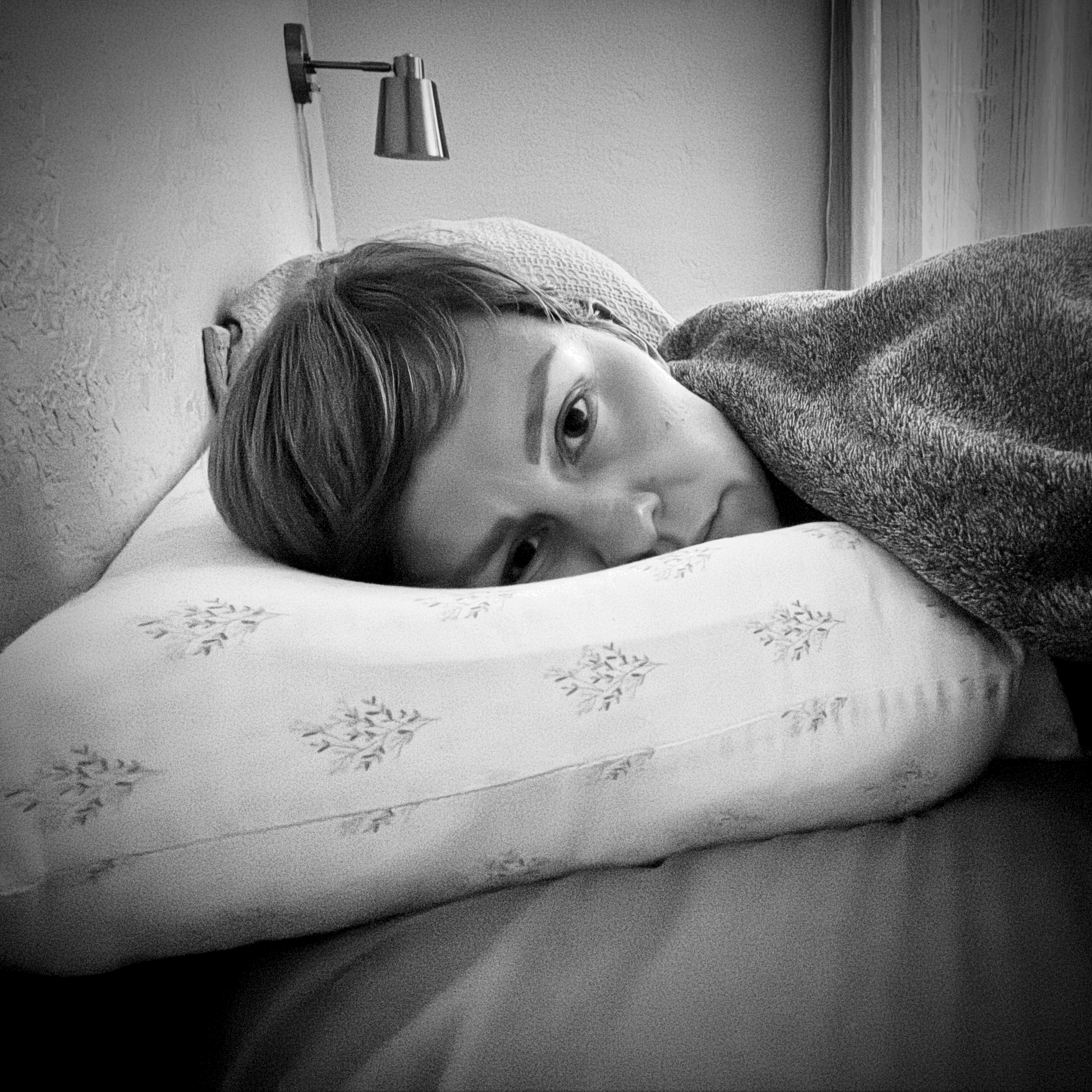
Autistic Burnout: What It Feels Like, How It Impacts Daily Life, and Ways to Recover
Autistic burnout isn’t just exhaustion — it’s a total shutdown of mind and body after too much masking, stress, and sensory overload. In this post, I share what autistic burnout really feels like, how to recognize the signs, and gentle ways to recover through rest, self-awareness, and compassion. Whether you’re autistic or supporting someone who is, this is a guide to understanding, empathy, and resilience.
By Frankie
Disabled Air Force Veteran | Chronic Illness Advocate | Medical Nerd
Understanding Autistic Burnout: Symptoms, Causes, and Coping Strategies
Today, I want to discuss something that doesn’t get talked about enough: autistic burnout. Whether you’re autistic yourself or supporting someone who is, this post will help you understand what burnout feels like, how it manifests in daily life, and ways to cope and recover.
What is Autistic Burnout?
Autistic burnout is a state of intense physical, emotional, and cognitive exhaustion that results from chronic stress, masking, and navigating a world designed for neurotypical people. Researchers describe it as a combination of prolonged social, sensory, and executive function demands that exceed an autistic person’s capacity to cope. Unlike regular stress or tiredness, autistic burnout can involve:
Persistent fatigue that isn’t relieved by sleep
Cognitive difficulties, like slow processing and memory problems
Emotional exhaustion and detachment
Sensory sensitivities or overwhelm
For me, it’s a fatigue you can feel in your bones — one that sleep or rest alone doesn’t fix. Often, I don’t notice how severe it is until it becomes overwhelming. My husband usually notices changes before I do. He’ll ask, “Do you think you might be in burnout?” and that’s when I start processing what’s happening inside me.
Signs and Symptoms of Autistic Burnout
When I experience burnout, it affects every part of my life:
Cognitive challenges: Thinking slows, memory worsens, and sometimes I can barely process information.
Communication difficulties: Spoken language becomes harder; I may hear something differently than what was said or need repetition.
Emotional exhaustion: I have little energy for emotions, often switching to research mode, focusing on my blog, or dissociating.
Social withdrawal: Phone calls, text messages, and social interactions feel draining.
Physical fatigue: A deep, bone-level exhaustion that isn’t relieved by rest alone.
Coping with Autistic Burnout
Recovery isn’t about pushing through — it’s about listening to your body and mind. For me, coping strategies include:
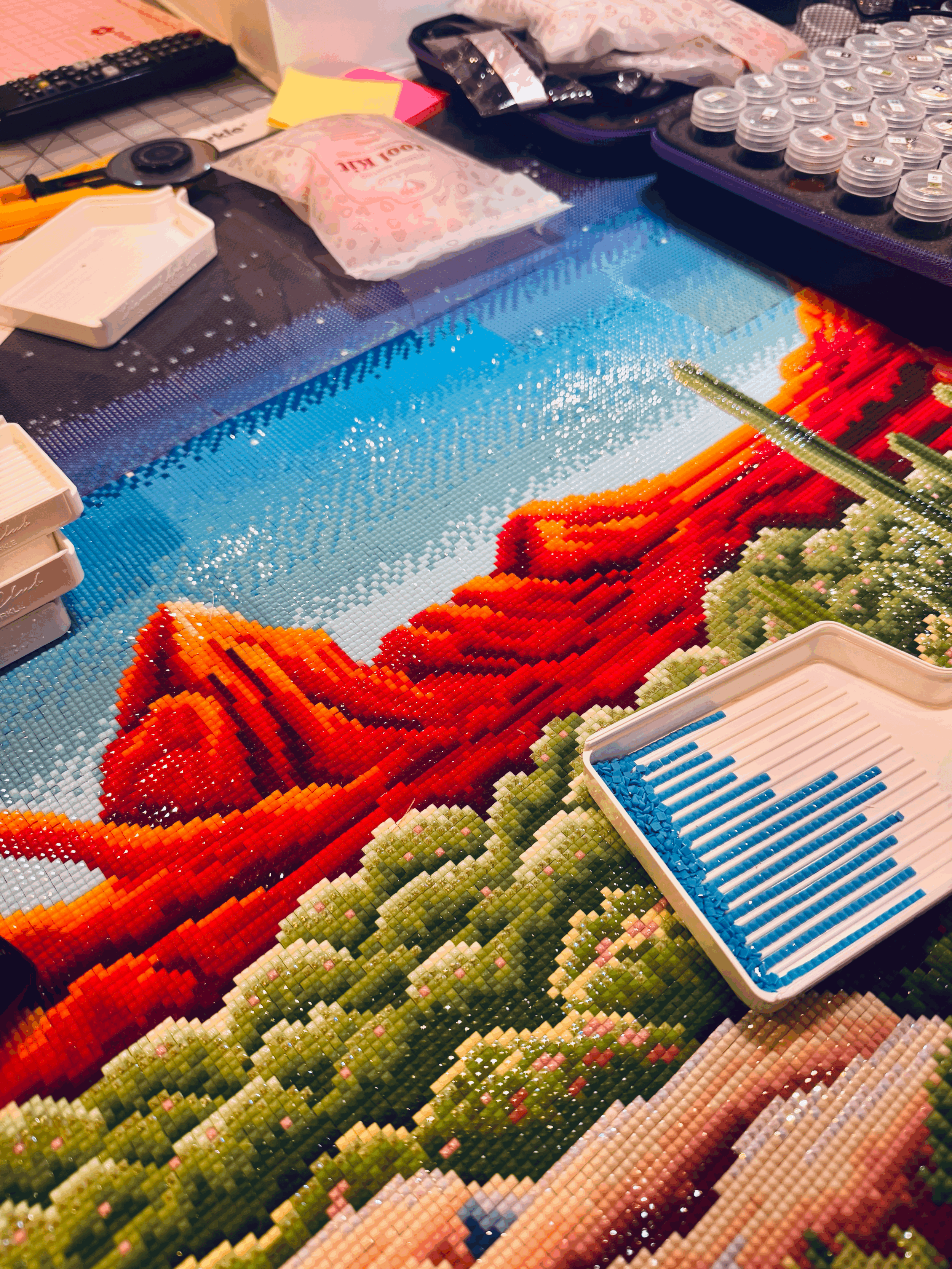
Engaging in special interests, like diamond painting
Taking restful downtime, such as relaxing in bed
Cuddling with my dog Phoebe, whose comfort and presence calm my nervous system
Spending time in nature, soaking in the quiet and grounding energy of the outdoors
Maintaining exercise routines, like lifting weights and walking, to keep my body grounded (IF you have the spoons)
Preserving structured routines, which provide stability during overwhelming periods
Recognizing the signs early and giving yourself permission to rest is an act of self-compassion.
Advice for Supporters
If you’re supporting someone autistic:
Understand that autistic burnout is real and serious, not laziness.
Offer patience, understanding, and practical support.
Respect their need for boundaries, rest, and low-demand activities.
Follow me on Facebook, YouTube, and Instagram for more about living with autism, chronic illness, and brain injury — and as always, stay resilient ❤️🩹